Showing posts with label Childhood Illness. Show all posts

Friday, February 10, 2012

When the Zebra is a Horse

Is this a zebra, a horse, or a Photoshop disaster?*

Here's a trivia question for the doctor-folks who follow my blog:  What's the most common cause of encephalitis of uncertain etiology in children and young adults?  Hint: It's not herpes, rabies or even West Nile.

It's anti-NMDA receptor encephalitis.

If you already know what I'm talking about, I'm impressed.  I had never heard of this entity until today, when our chair forwarded everyone in the medicine department a report from the California Encephalitis Project (CEP).  In fact, anti-NMDAR wasn't even discovered until 2007.

Encephalitis is inflammation of the brain, resulting in fever, confusion, seizures and sometimes permanent neurologic damage and death.  It's usually caused by viruses and sometimes bacteria, when it accompanies meningitis.  Anti-NMDAR is not an infection, however.  NMDA is a ubiquitous neurotransmitter, and in this disease, the body produces antibodies that attack the NMDA receptor, leading to gross neurological dysfunction. 

Anti-NMDAR can be a devastating illness.  It presents with hallucinations, language problems and vital sign instability, among other signs and symptoms.  In the CEP report, 40% of patients required life support for respiratory failure.  Fortunately, there is effective treatment for anti-NMDAR.  The majority respond to a potent cocktail of immune suppression -- the exact opposite of how you would normally treat infectious encephalitis.

And here's the surprising part of the report:  Out of 761 cases of encephalitis reported over the 3 to 4 year period, 47 were tested for NMDAR because of clinical suspicion.  Thirty-two, or 68%, tested positive.  In fact, even though only a fraction of cases were tested for anti-NMDAR, it was the most common cause of encephalitis in this case series.  Two-thirds of cases were in children.

Now encephalitis is still a very rare illness, with an incidence rate of 1 out of 200,000 in the U.S., so even if anti-NMDAR is a common cause of encephalitis, it's still an extremely uncommon disease.  (Please do not charge into your pediatrician's office demanding to have little Johnny tested because he has a fever or is moodier than usual.)  The CEP only collected cases of encephalitis of unknown etiology, so many of the diagnosed viral cases were excluded from this analysis, artificially inflating the relative frequency of anti-NMDAR.  On the other hand, because so few doctors are aware of this disease, we are probably undertesting and missing cases.

In medicine, we have a saying:  When you hear hoofbeats, think of horses, not zebras.  In other words, don't go on an expensive hunt for a rare disease unless you have a compelling reason to do so.  When it comes to childhood encephalitis, though, anti-NMDAR may turn out to be the proverbial horse.

*It's a zorse (zebra-horse hybrid).

Tuesday, January 10, 2012

Catching Your Death of Cold

Growing up, many of us were admonished by our moms to wear our coats, or we'd "catch our death of cold."  Chinese grandmas have a particular fondness for bundling kids so tightly that they're splinting their joints.  We know now, of course, that being cold doesn't cause colds; viruses do. 


But like many things in science, the evidence isn't as clear-cut as you might think.  Multiple studies have found a strong link between outdoor temperature, as well as low humidity, and the risk of respiratory infections.  One study, for instance, found a 4% increase in upper respiratory infections with every 1 C decrease in temperature.  Influenza shows strong seasonality in temperate regions, with peak infection rates in winter, but none in tropical areas.  Of course, this doesn't prove cause and effect.  The conventional wisdom is that colds and the flu are more common in winter because of an increase in indoor crowding.

There is another possible explanation for this phenomenon.  Our first line of defense against respiratory viruses is that cozy mucus blanket lining our noses.  Microscopic hairs sweep the germ-laden mucus towards the back of the throat, where it's swallowed and sterilized by stomach acid.  "Nasal mucus velocity" drops significantly in cold weather, preventing viral clearance.  (Sounds like one of the less popular Magic School Bus episodes.)  Cold also impairs the function of macrophages, white blood cells that ingest germs.  Finally, many respiratory viruses replicate best at lower temperatures.


Guinea pig studies do confirm an increased risk of transmission of the flu in cold, low humidity lab conditions.* 

However, there are no studies on the protective
properties of the Snuggie, in guinea pigs or humans.

While there are no human trials on the direct effects of low temperature on influenza infection, controlled studies exist for the common cold.  In one 1968 study, forty-nine "volunteers" from the Texas State Department of Corrections were nasally inoculated with "virus-containing fluids" collected from sick Marines.  Half were then subjected to cold conditions, involving, among other things, sitting in a 4 C (39 F) room in shorts and undershirts for a couple of hours.  The two groups showed no difference in the rates of rhinovirus shedding or cold symptoms, and you can bet this study had 100% follow-up.


Another study took the opposite approach, looking at the effects of hot, humidified air in university students who were also experimentally infected with rhinovirus.  This time, the subjects were comfortably ensconced in private hotel rooms and administered either placebo vapor or warm steam.  There was no difference in the primary outcome of viral shedding.  Another randomized, double-blind trial found a reduction in cold symptoms with hot, humidified air, but again, no decrease in viral shedding.

Case closed, right?  Believe or not, research in this area continues, almost 2,000 years after the Greek physician Galen wrote about the four humors ("phlegmatic" being the "cold and moist" humor).  The latest was a study published by the Common Cold Centre in the UK, which randomized180 volunteers to place their feet in cold water or an empty bowl for 20 minutes.  Why did the investigators decide to chill feet instead of noses?  Their rationale was that chilling of the body surface decreases the temperature of mucosal surfaces, via reflex constriction of the blood vessels in the nose.   Over the next five days, significantly more of the chilled subjects developed cold symptoms than the control group - 29% vs. 9%.  Despite the relatively large sample size and achievement of "statistical significance," this study sounds like an grade school science project, and not a winning one at that.  The subjects were aware of the hypothesis of the study -- that chilling might affect the development of cold symptoms -- so the nocebo effect may have been in play.**  None of the volunteers underwent viral cultures to confirm infection.  And it's hard to believe a mere 20-minute foot dip could triple your chances of getting sick.  So is bundling up really going to protect you from infection?  Probably not.


Then again, would it kill you to listen to your mother?


*Guinea pigs were discovered in 2006 to be an excellent experimental model for the flu.  I have no idea why it took so long figure this out, when guinea pigs have been, well, guinea pigs since time immemorial.
**A nocebo is the opposite of a placebo: something that makes you feel worse, though it has no actual, independent effect.

Wednesday, December 21, 2011

Meeting Mr. Sa (a.k.a. Frank Pus)

As a working mom, I accept that my toddler is going to be exposed to drool, snot and microscopic fecal contamination from his fellow daycare inmates.  But I draw the line at pus.  So imagine my dismay when one of my son's caregivers pulled me aside and said, "I get a lot of boils. Would you mind taking a look?"  Whereupon she rolled up her shirt, revealing a lovely specimen, which fortunately had already burst and dried up.  Most boils and abscesses are caused by Staphylococcus aureus, and in my area, about 60% are methicillin-resistant.

MRSA (along with some forms of strep) is commonly described as the "flesh-eating bacteria" in the media.  While MRSA can result in serious, life-threatening infections, more often it causes nettlesome skin infections that may require incision and drainage and treatment with specific classes of antibiotics.  The classic presentation is that of a "spider bite," sans spider.

                                                 Source: Dermatlas.org

It used to be that MRSA was seen primarily in hospitalized patients, but in the past 10 to 15 years, we've seen a meteoric rise in a particular strain in the community.  MRSA is contagious, and pediatric outbreaks have been described in daycare centers and on sports teams.

So what can you do to protect your child?  Unless you plan on raising a bubble boy or girl, MRSA is not entirely preventable.  It's best to avoid sharing sweaty sports equipment and towels, which are often colonized.  And there is another thing you can do to reduce the risk: Avoid unnecessary antibiotics.  Antibiotics wipe out the good bacteria with the bad, allowing resistant strains to flourish.  And many conditions frequently treated with antibiotics, such as ear infections, tend to resolve on their own anyway.

A recently published study looked at all the MRSA diagnoses in kids from 400 general practices in the U.K., and compared them to same-age controls.  They then looked at the kids' exposure to antibiotics 1 to 6 months prior to the MRSA infection.  Children who were infected with MRSA were three times as likely to have received antibiotics during that time period than those who weren't infected.  The more antibiotics received, or the stronger the antibiotic (i.e., those with the broadest spectrum of activity), the stronger the association.  Of course, it's possible that a child receiving multiple antibiotics is just more prone to infections, and the antibiotics per se are not causing the MRSA.  The authors still found a correlation after controlling for baseline diseases, such as diabetes and asthma. 

Here's another disturbing possibility:  some of those kids might have actually picked up the MRSA from the doctors' office.  Healthcare workers have colonization rates of up to 15%, and you know that most of us don't wash our hands after we pick our noses.  Even worse, one study found that a third of stethoscopes in one ER were contaminated by MRSA.  Since I work in a hospital, I could hardly blame my daycare if my son had become infected.

Bringing home the superbug

I admit I was caught flat-footed by this curbside consult, and I ended up advising my son's caregiver to see her own doctor.  I told her a little about decolonization protocols, which involve bathing with antiseptics, taking antibiotics and lacing your nostrils with Bacitracin.  Unfortunately, unless you place all your clothes, bedding and pets on a bonfire*, re-colonization is the norm, so these protocols aren't often used.  Though I told her she had a bacterial infection, I avoided using the M-word in front of the other parents.  I also didn't recommend staying home during her outbreaks, though I did suggest she cover up her boils with gauze.  Afterwards I tried to hand off my kid to the other providers as discreetly as possible.  This happened many years ago, and I still wonder whether I did the right thing.


What would you have done?


*Kidding!  I don't want to be held responsible for any hamster roasts.

Tuesday, October 18, 2011

Ears Lookin' at You, Kid!*


Last week, JoJo spiked a temp to 102.7.  Since he was already scheduled for his 18-month visit, I had the pediatrician gave him the once over.  She diagnosed him with otitis media, or middle ear infection, but her diagnosis was essentially just an FYI.  Since ear infections often get better on their own, the doc recommended antibiotics only if he didn't improve in the next 48 hours.

I knew she was right.  But dadgammit, I wanted to start those antibiotics so he could get back to daycare ASAP, and I could get a good night's sleep!  It's times like these when it's tough to be an Evidence-Based Mommy.

Here's the argument against routine antibiotics:  Some ear infections are caused by viruses, and as you know, antibiotics don't kill viruses.  Even mild bacterial infections self-resolve at times.  Antibiotics can shorten the course of illness and prevent rare complications such as bone infection and hearing loss, but at the cost of increasing drug resistance.  So what may help a patient on the individual level may hurt patients on a societal level.

A recently updated meta-analysis of eleven randomized, double-blinded trials of over 2000 children with ear infections found only a small benefit with antibiotics: 78% in the placebo groups recovered spontaneously within 2 to 7 days, compared to 84% in the antibiotic groups.  There was no difference in serious complications.  Those on antibiotics also had a 4% absolute increase in vomiting, diarrhea and rash.   So taking the 6% benefit and subtracting the 4% detriment, you get, on balance, a measly 2% absolute benefit from taking antibiotics. A review of four other trials found that there was no difference in starting antibiotics immediately versus waiting 48 hours for spontaneous improvement.  So even from the standpoint of an individual child, you could make a strong argument to watch and wait. There were certain subgroups that benefited more from immediate antibiotics: children under 2 who had infections on both sides, or those with pus pouring out of their ears.  In general, though, antibiotics were almost a wash.

Contrast these results with those of a study published this year.  In this randomized trial of children with ear infections, treatment failed in 45% in the placebo group, compared to 19% in the antibiotic group, with an absolute benefit of 26% - much better than the 4% reported in the past.  Not only that, but antibiotics led to resolution of fever within 6 hours, as well as fewer days of missed work in parents whose kids were in daycare.  Sadly, these benefits still came with a price: a 25% increase in diarrhea in the antibiotic group. So pick your poison: irritable baby or irritable, diaper-changing parent?

Still, you might wonder why the results of this trial were so much more impressive than that of previous studies. The 2011 study had very strict criteria for middle ear infection, which included a pneumatic otoscopic exam (basically, blowing air into the canal and looking for decreased movement of the eardrum).  Although medical students learn this technique, I can tell you that it's rarely used in the primary care setting.  Most of the time, pediatricians are just trying to grab a 1-second peek into a screaming baby's ear, and crying itself pinks up the eardrums by dilating blood vessels.  Studies have shown that these infections tend to be overdiagnosed, especially when earwax is obstructing the view, so it's no wonder that antibiotics are often of marginal benefit.

So what's a parent to do with all this conflicting information?  If your kid's doctor wants to prescribe antibiotics for a middle ear infection, ask her two questions:

1)  Is this a pretty clear-cut diagnosis?  When doctors are "certain" of their diagnosis, the probability of a "real" otitis media is actually 76% -- which believe it or not, is pretty accurate for a diagnosis based purely on history and physical exam.

2)  Do you think it's safe to wait 48 hours to see if my child gets better on his own?

In JoJo's case, I waited, as his doctor thought it would be safe to observe him off antibiotics.  He was better within two days  This time at least, it looks like I picked my poison wisely.**

*Sorry, I know this is a groaner of a title.  As Fred said to George after his ear was sectum sempra'd off, "Pathetic!  With the whole wide world of ear-related humor before you....?"


**Which hasn't always been the case.  I decided not to give my oldest son the antibiotics prescribed to him for an ear infection.  He seemed to improve, but on a routine visit a few weeks later, his pediatrician found he had a persistent infection.  When he puzzled aloud over why my son "didn't respond" to the antibiotics, I was forced to come clean.  My son was deemed cured after a week's worth of treatment/diarrhea, but I've always wondered if my poor maternal decision-making was to blame for his current, frequent refrains of "But Mom, I didn't hear you!"

Thursday, September 8, 2011

Doctor My Eyes

 Patient Zero

I meant to post an entry earlier this week but was waylaid by a nasty viral infection.  Though infection is an occupational hazard of working in the hospital, I'm much more likely to pick up something from my 1-year-old, who in turn picks it up from his daycare, Little Lovin' Petri Dish.


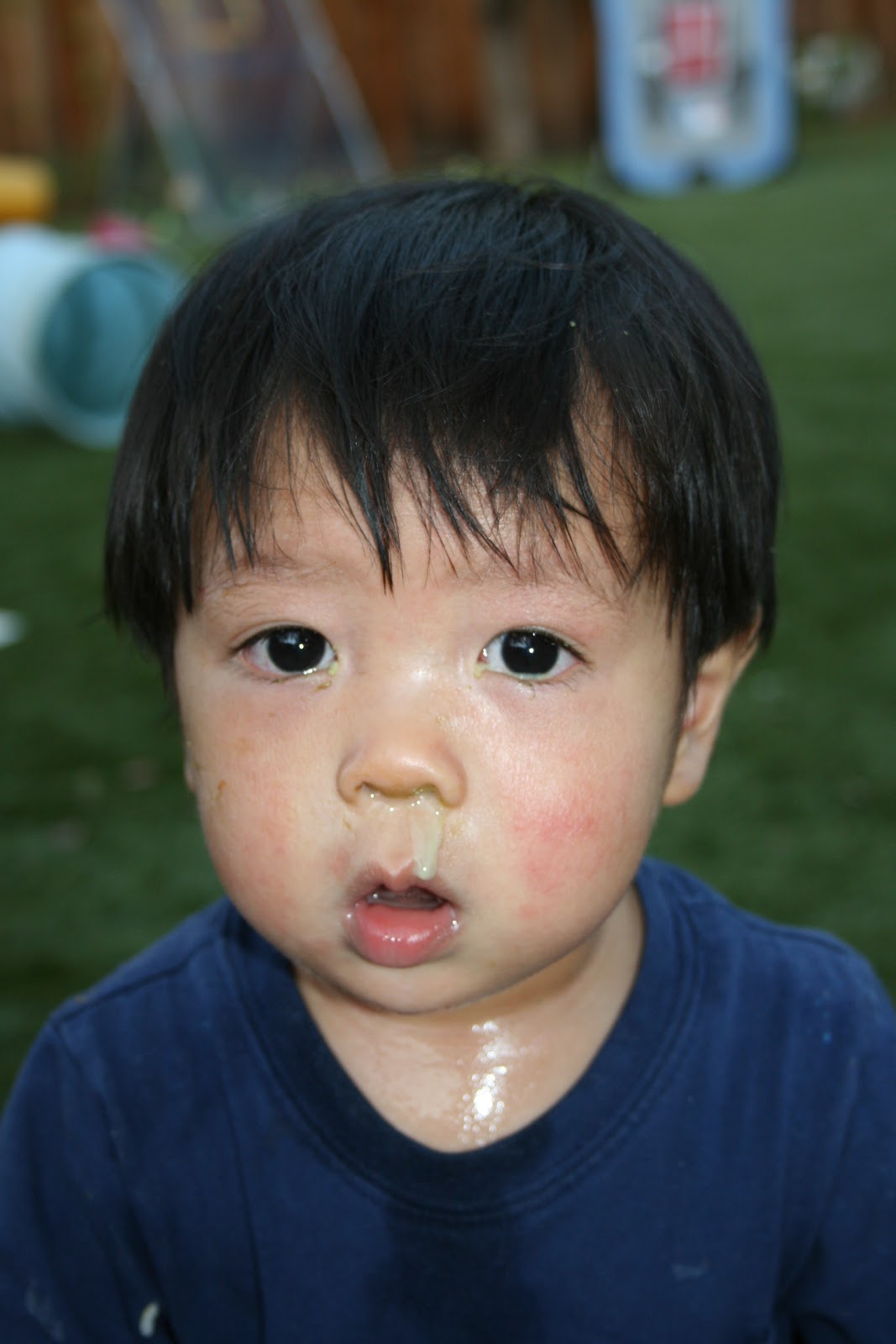
JoJo started coughing and running a fever several days ago, followed by copious oozing from his eyes and nose, finishing up with the dreaded pink eye.  Unlike fever, which you can mask for 6-8 hours with Tylenol and ibuprofen, there is no easy way to hide a pink eye from your daycare provider. (For those of you who question my morals and judgment, I admit that the blog name "Bad Mommy" was already taken.)  So Joseph was banished to his home, where he ended up infecting three other members of his family instead of the tykes at LLPD, who probably gave it to him in the first place.


By day five, he was already starting to improve, but my husband brought him to the doctor just to get a note okaying his return to daycare.  He returned with a note, as well as some antibiotic eye drops.  I took the note and tossed the bottle.  DO NOT DO AS I DID. ALWAYS TELL YOUR DOCTOR WHEN YOU ARE PLANNING TO DISOBEY HIS OR HER  ORDERS.*  But I have my evidence-based reasons, and here they are.

Pink eye, or infective conjunctivitis, is caused by viruses about half the time, and bacteria the other half.  So automatically you know that antibiotic drops are not going to work in half of patients with conjunctivitis.  Unfortunately, it's often hard to distinguish between bacterial or viral causes.  There are some clues in the history and exam, but they're not that reliable.  You could also swab the eyeball, which is as fun as it sounds, but those results can take days to come back.  So most pediatricians just end up prescribing the drops to anxious parents.  (You read that right; none of the kids are asking for drops.)


There have been five good randomized, placebo-controlled trials of antibiotics drops for pink eye.  In the largest one ("Chloramphenicol treatment for acute infective conjunctivitis in children in primary care: a randomised** double-blind placebo-controlled trial."), 326 children in the UK underwent eyeball swabs, and then were randomized to antibiotic drops or borax water.  That's right -- half the kids had to endure an eye poke with a Q-tip, followed by dishwashing detergent.  (The harmless, low- concentration borax was added to make the water resemble the active drug.)  At the end of a week, there was no difference in the cure rates between the two groups.  Even in the subset of patients with confirmed bacterial conjunctivitis, 85% of those on antibiotics were symptom-free at 1 week, compared to 80% on placebo -- a nonsignificant difference.  The researchers did, however, find a difference in the duration of illness.  Those on antibiotic drops cut short their illness by half a day.  Other studies on bacterial conjunctivitis have shown similar results, with antibiotics shortening the duration of illness, with minimal effects on actual cure.


So is a 12-hour reduction in symptoms worth it?  Topical antibiotics aren't particularly toxic or expensive.  An additional benefit is that antibiotics do clear bacteria faster (as proven by repeated eyeball swabs -- these kids have done their duty for science), theoretically reducing infectivity and getting them back to school or daycare faster.  But of course, there are still the downsides of increasing antibiotic resistance and uncommon but potentially serious drug reactions.


In my case, I opted not to treat JoJo because I was convinced he had a virus (you don't typically get fever, cough or runny nose with a bacterial conjunctivitis), and he was already improving.  If your kid comes down with pink eye, though, you really should consult with your pediatrician.***  In some severe cases, or in newborns, treatment is mandatory to preserve vision.  But if your doctor hands you a prescription for antibiotic drops, make sure to ask him or her, "Do we really need to use this?"


*My lawyer friends made me write this.  Also, it's not nice to lie to your doctor.
**I did not misspell 'randomised.' The entire country of England does.
***See above.* 

Wednesday, August 10, 2011

The End of Chicken Pox?

Medical students are taught that chicken pox pox* are classically described as “dewdrops on a rose petal.”  How the textbook authors got from this:


to this:


is beyond me.  I suspect some dermatologist got a little carried away after taking a creative writing course.  Now, any Boomer mother would be able to diagnose chicken pox in her child without the use of a gardening manual.  But believe or not, there may soon come a generation of doctors who will be unable to diagnose chicken pox by sight alone – and that’s a good thing.  Why?  Because it means that the varicella vaccine is working.

Varicella zoster is the virus that causes chicken pox, and the vaccine has been given to kids in the U.S. since 1995.  The single-dose shot is about 85% effective in preventing chicken pox, and close to 100% effective in preventing severe cases (typically defined as a horrifying 500 or more skin lesions, or requiring hospitalization).  The journal Pediatrics recently published a report showing that the number of deaths due to varicella has dropped by almost 90%.  ("Near elimination of varicella deaths in the US after implementation of the vaccination program”)  In fact, the reduction in mortality exceeded that predicted by computer modeling when the vaccine first came out.

Now if you look at the vertical axis, you’ll see that the absolute number of deaths, even before the advent of the vaccine, has always extremely low.  Most kids who fall ill will do fine with a little chicken soup (or, in my family, chicken jook).  In EBM parlance, the number needed to vaccinate is 3 million kids in order to prevent one death.  But that’s not really why we get our kids vaccinated, is it?  It’s more to prevent the discomfort, inconvenience and lost productivity of a case of chicken pox.  Given that over 90% of today’s adults have been infected with chickenpox, and the 85% effectiveness of the vaccine, that’s a number needed to treat of about 2 to prevent human misery.  And that’s a pretty good number in my book.

One last observation:  Since 2006, pediatricians now give a second, booster dose of varicella vaccine.  The number of breakthrough infections with the 2-dose vaccine is even lower than with the 1-dose.  So if, in the future, your doctor fails to diagnose chicken pox in your child without ordering a blood test, don’t be too hard on him!

(*Sorry, I know that sounds like “woodchuck chuck.”)